How to Homeschool with the IB PYP Without Recreating School at Home
Learn how to homeschool with the IB PYP using simple inquiry-based learning at home. Help your child ask better questions, reflect, build skills, and connect learning to real life.
IB PYPHOMESCHOOLING
7/10/20268 min read

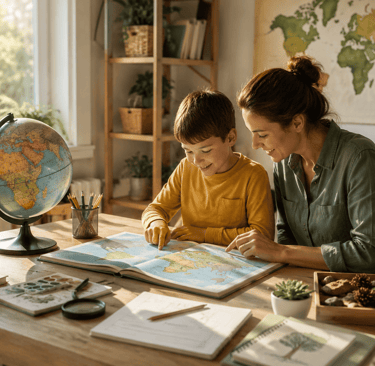
You do not need to recreate an IB school at home to use the heart of the PYP. You do not need a classroom display board, a staff meeting, a wall of laminated resources, or a daily schedule that looks like it was approved by a committee of very organized people with matching folders. You can bring inquiry-based learning into your homeschool in a simple, meaningful, parent-friendly way.
If you are drawn to the IB Primary Years Programme, often called the PYP, it is probably because you want more than worksheet completion. You want your child to ask thoughtful questions, think for themselves, reflect on mistakes, care about the world, and connect learning to real life. Then you start researching the PYP and meet words like transdisciplinary, agency, approaches to learning, central idea, and learner profile.
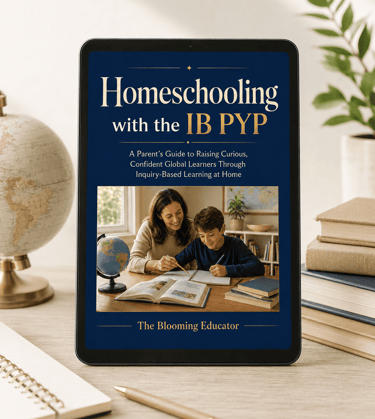
At that point, the kettle starts looking very interesting.The good news is that PYP-inspired homeschooling does not need to feel complicated. At its heart, it is about curiosity, connection, reflection, and action. That is exactly why I created Homeschooling with the PYP, a practical parent guide to using inquiry-based learning at home without turning your kitchen into a mini international school.
What Is the PYP, Really?
The IB Primary Years Programme is a framework for learning that encourages children to explore big ideas, ask questions, make connections, reflect on their learning, and take meaningful action. In simple parent language, the PYP helps children learn how to think, not just what to remember.
Instead of treating subjects as separate boxes, the PYP connects learning through big ideas. A question about food, for example, can lead to geography, culture, farming, health, measurement, family traditions, environmental care, and writing.One question can open many doors.
PYP-inspired learning asks:
What are we wondering?
How can we find out?
What connections can we make?
How can we show what we understand?
What can we do with what we learned?
This is not about making learning more complicated. It is about making learning more meaningful.
Why the PYP Works Beautifully at Home
Home is already full of inquiry opportunities. A question about breakfast can become a conversation about where food comes from. A walk outside can become science, observation, sketching, writing, weather, habitats, and care for the environment. A family story can become identity, migration, history, memory, language, and belonging.
A messy laundry basket can become classification, responsibility, self-management, and a quiet reminder that socks have commitment issues. You do not need to manufacture learning moments all day. Many of them are already there. Inquiry-based homeschooling helps you notice them, shape them, and deepen them.
When your child asks, “Why do people live in different kinds of homes?” you can explore weather, culture, materials, geography, safety, family needs, and design. When your child asks, “Where does rice come from?” you can look at a map, read a story, compare food labels, cook a meal, talk about farming, and reflect on gratitude. This is the beauty of PYP-inspired homeschooling: it turns ordinary life into connected learning.
From Parent to Learning Coach
Many homeschool parents feel pressure to know everything. You may think, “How can I teach science if I barely remember what mitochondria do?” Or, “How can I guide inquiry if I still spell transdisciplinary with emotional support?” Here is the relief: you do not have to be the expert in every subject.
In inquiry-based learning, your role is not to deliver every answer. Your role is to guide curiosity. You become a learning coach. That means you help your child ask better questions, find useful resources, think carefully, make connections, reflect, and keep going when learning gets messy. Some of the most powerful phrases you can use are beautifully simple:
“I don’t know. Let’s find out.”
“What do you notice?”
“What do you think?”
“How could we investigate this?”
“What changed in your thinking?”
These questions teach your child something deeper than facts. They teach your child how to learn. And yes, sometimes the inquiry begins beautifully. Other times, your child asks one question and somehow you are watching a video about whether octopuses have personalities while lunch burns slightly. This is why structure matters too.
What a Home Unit of Inquiry Can Look Like
A Unit of Inquiry sounds official, but at home it can be simple. You do not need a giant planner or a three-week project that takes over your dining table and threatens your emotional stability. Use this simple formula:
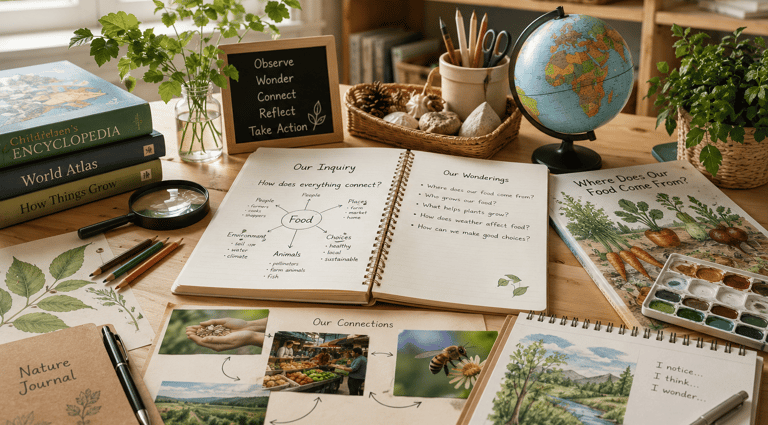
Child’s Question → Big Idea → Lines of Inquiry → Activities → Reflection → Action
Here is an example.
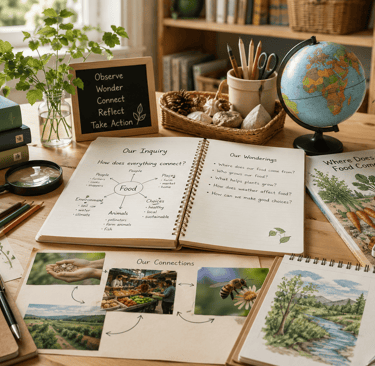
Child’s question: Where does our food come from?
Big idea: Food connects people, places, and choices.
Lines of inquiry:
Where food comes from
How food reaches our homes
How our choices affect people and the planet
Activities:
Read a book about farming or family meals
Look at a map
Compare food labels
Cook a recipe
Draw the journey of one food
Track food waste for two days
Reflection:
What surprised us?
What did we think before?
What do we think now?
Action: Plan one low-waste meal using food already at home.
That is a Unit of Inquiry. Not perfect. Not overwhelming. Not requiring a family press conference. Just one real question, explored thoughtfully.
But What About Reading, Writing, Math, Science, and Social Studies?
This is one of the biggest parent concerns. If learning is inquiry-based, are children still covering the basics? Yes. Inquiry does not remove core academics. It gives them a meaningful place to live. Through inquiry, reading might include books, maps, recipes, signs, labels, articles, poems, and instructions. Writing might include journals, questions, lists, captions, diagrams, reflections, letters, stories, and explanations.
Math might include measuring ingredients, comparing prices, sorting objects, collecting data, making graphs, reading charts, budgeting, and timelines. Science might include observing plants, testing materials, tracking weather, exploring habitats, predicting, classifying, and investigating cause and effect. Social studies might include maps, family traditions, community helpers, history, migration, food systems, transport, rules, responsibilities, and global connections.
You do not need to force every subject into every inquiry. That is how a simple question about apples becomes a 17-part curriculum unit and a parent staring at a glue stick with regret. Use what fits naturally. Let the inquiry guide the skills.
The Learner Profile at Home
The PYP is not only about academics. It is also about who children are becoming. The IB Learner Profile gives language for traits like being curious, thoughtful, reflective, caring, principled, open-minded, balanced, and courageous. At home, these traits show up in ordinary family life. A child is an Inquirer when they ask why birds migrate or why the moon seems to follow the car. A child is Caring when they comfort a sibling or help water a plant.
A child is Principled when they tell the truth, even when the truth involves spilled glue. A child is Reflective when they say, “Next time I would try a different way.” A child is Open-minded when they listen to another perspective or try a new food without acting like the broccoli personally betrayed them. You do not need to turn the Learner Profile into a behavior chart. The goal is not performance. The goal is noticing growth. A simple phrase can be enough:
“I noticed you kept trying when that was hard. That was brave.” “I noticed you listened before answering. That was open-minded.” “I noticed you told the truth. That was principled.” Small moments shape identity.
ATL Skills: The Learning Skills Underneath Everything
The PYP also includes ATL skills, or Approaches to Learning. In plain language, these are the skills children use to learn well:
Communication skills
Thinking skills
Research skills
Social skills
Self-management skills
These skills grow naturally at home. Communication grows through storytelling, discussion, disagreement, and explaining ideas. Thinking grows through comparing, problem-solving, predicting, and asking better questions. Research grows through books, interviews, observation, maps, and child-safe searching. Social skills grow through family projects, turn-taking, shared decisions, and repairing conflict.
Self-management grows through routines, chores, planning, organizing materials, managing emotions, and returning to learning after frustration. This is why PYP-inspired homeschooling is so powerful. It does not only ask, “Did my child finish the task?” It asks, “What kind of learner is my child becoming?”
Assessment Without Report Cards
Assessment at home does not have to mean tests, grades, or red pens. In a PYP-inspired home, assessment simply means noticing learning. You can notice learning through learning journals, portfolios, photos of projects, conversations, drawings, diagrams, student-led reviews, and reflection prompts. A child who says, “I used to think food just came from the shop, but now I know people grow it, move it, sell it, and cook it,” has shown understanding. No test required. No red pen harmed.
A simple portfolio can also help you see growth over time. It does not need to include every paper your child has ever touched, including the suspicious drawing from three months ago that may or may not be a potato. Choose a few meaningful pieces: a journal page, a photo of a project, a drawing, a map, a short written explanation, or one sentence your child said that showed understanding.
Once a month, look through the pieces together and ask:
What are you proud of?
What can you do now that you could not do before?
What changed in your thinking?
What do you want to keep practicing?
Assessment becomes less about proving and more about understanding.
Raising a Global Learner From Your Living Room
One of the most beautiful parts of PYP-inspired learning is global thinking. But global learning does not mean your child must memorize every flag before breakfast. A global learner is curious about people, places, cultures, systems, stories, and perspectives beyond their own experience. This can begin with simple things:
A book from another culture
A family recipe
A map
A song
A banana
A bowl of rice
A story about migration
A conversation about how children live in different places
Global learning should not overwhelm children with every world problem. It should open windows. One window at a time. It helps children replace judgment with curiosity.
Instead of, “That food is strange,” they learn to say, “That is new to me.”
Instead of, “Why do they do that?” they learn to ask, “What can we understand about this tradition?”
That shift matters. The world needs children who can ask better questions, listen more carefully, and care beyond themselves.
What Makes Homeschooling with the PYP Helpful?
I wrote Homeschooling with the PYP to make inquiry-based learning feel practical, warm, and usable for real families. Not imaginary families with spotless tables and children who always sharpen pencils before learning. Real families. The guide walks you through:
What the PYP is in parent-friendly language
How to become a learning coach
How to build your first home Unit of Inquiry
How to create a weekly inquiry rhythm
How to nurture the Learner Profile at home
How to build ATL skills naturally
How to assess and reflect without report cards
How to raise globally minded learners from everyday life
How to use printable planners, trackers, prompts, and project starters
It is designed for homeschool parents, hybrid learning families, tutors, educators, and parents at IB schools who want to understand the PYP more clearly. It is an independent parent guide inspired by inquiry-based practices used in the IB Primary Years Programme. It is not an official IB publication and does not make a homeschool an authorized IB World School or official PYP provider.
Start Small
You do not need to transform your homeschool overnight. Start with one question. Read one book. Take one walk. Create one simple project. Ask one reflection question. Take one small action. Inquiry grows through small, steady moments. You are not just helping your child complete lessons. You are helping them notice the world, think deeply, ask better questions, reflect honestly, and care beyond themselves. That is the heart of PYP-inspired homeschooling. And it can begin at your kitchen table. Possibly beside a laundry basket.
Ready to Bring Inquiry-Based Learning Into Your Homeschool?
Homeschooling with the PYP is a practical, parent-friendly guide to using PYP-inspired learning at home without feeling overwhelmed. It will help you stop wondering whether you are “doing enough” and start building a homeschool rhythm rooted in curiosity, confidence, connection, reflection, and real-world learning.
Inside, you will find simple explanations, home-friendly examples, printable planning tools, reflection prompts, sample Units of Inquiry, ATL skill supports, Learner Profile trackers, and troubleshooting help for the weeks when inquiry gets messy, because it will.
Get your copy of Homeschooling with the PYP here: