
Lazy Isn’t the Problem: What Executive Function Really Looks Like
Lazy isn’t the problem. Learn what executive function really looks like in children and why brain wiring, not motivation, explains forgotten work, meltdowns, and shutdowns.
NEURODIVERSITYCHILD DEVELOPMENT
Lardi
12/23/20254 min read
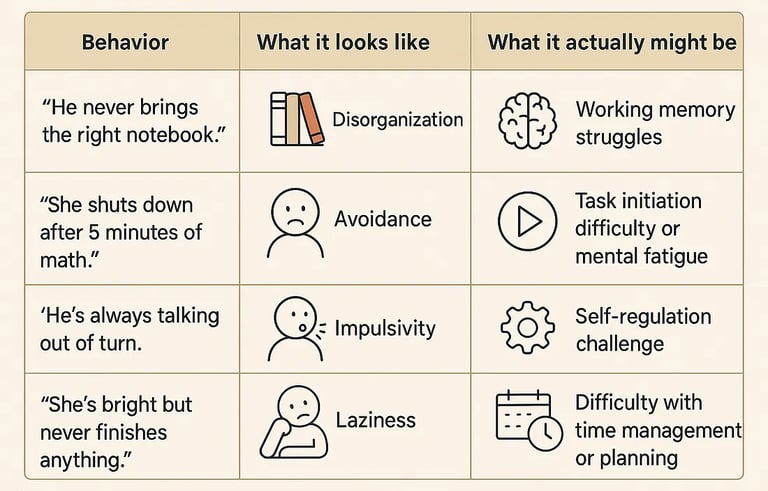
Let’s talk about the word lazy. It shows up quietly in parent conversations and loudly in moments of frustration. It slips out after the third incomplete worksheet or the fifth reminder to put shoes away.
“She just doesn’t care.”
“He could do it if he wanted to.”
I have heard it whispered in hallways and said aloud in conferences, usually with a sigh and a shrug. And every time, I pause. Not because I am judging the adult saying it, but because I know what usually comes next. Guilt. Confusion. A child who feels misunderstood. Most of the time, the issue is not motivation. It is executive function.
Executive function is the brain’s internal manager. It helps children start tasks, organize materials, shift attention, manage emotions, and remember what comes next. It is the system that allows a child to move from intention to action. And when it is underdeveloped or overwhelmed, everyday school life becomes exhausting. Not dramatic exhaustion. Quiet, grinding exhaustion.
Forgotten homework. Meltdowns during transitions. A spelling test abandoned halfway through writing a name. These are not moral failures. They are signs that the brain is working harder than it should just to keep up.
For many children, especially those with ADHD, autism, or learning differences, executive function is still under construction. Sometimes the blueprints are there, but the scaffolding is missing. So no, your child is not lazy. They are likely overwhelmed, under-supported, and doing the best they can with a brain that has not yet mastered when to press Start, Pause, or Save.
What Executive Function Really Does
If executive function were a person, it would be the one quietly keeping everything running behind the scenes. It helps a child decide how to begin a task, what order to do things in, where materials belong, how long something might take, and how to recover when frustration hits. Without it, even simple requests feel heavy. “Put your bag away and start your homework” sounds straightforward to an adult.
To a child with executive function challenges, it can feel like being handed five invisible steps with no map.This is why capable children are so often misunderstood. They know the content. They understand the lesson. But they cannot always translate that understanding into action on demand. And because executive function struggles are invisible, they are often mistaken for defiance or disinterest.
What It Looks Like in Real Life
I once worked with a student who could explain complex ideas beautifully in conversation but froze when faced with a blank page. Her desk was a constellation of half-finished papers and misplaced pencils. Adults kept saying she was careless. She was not. She was overwhelmed. When we added a simple visual checklist and reduced the number of decisions she had to make at once, something shifted.
Not overnight, but steadily. She started completing work. Not because she suddenly cared more, but because the task finally felt possible. This is the pattern I see again and again. A child who cannot start is labeled unmotivated. A child who forgets materials is labeled irresponsible. A child who melts down during transitions is labeled difficult. In reality, these are signs of executive load exceeding capacity.
What the Science Tells Us
Neuroscience is clear on this. Executive function develops gradually and does not fully mature until well into adulthood. According to the Harvard Center on the Developing Child, these skills are shaped by experience, environment, and neurological wiring.
Research consistently shows that children with executive function challenges are more likely to struggle academically and emotionally. But it also shows something hopeful. Supportive, structured environments dramatically improve outcomes. In other words, this is not about lowering expectations. It is about changing support.
What Actually Helps
Supporting executive function means making the invisible visible. When adults externalize what the brain is struggling to hold, children can finally focus on learning instead of survival. Visual schedules, timers, color-coded folders, and checklists are not crutches. They are scaffolds.
Breaking tasks into smaller steps reduces cognitive load. Practicing transitions with warnings and cues helps the brain prepare to shift. Allowing brief pauses for emotional regulation prevents shutdown before it begins. And perhaps most importantly, effort needs to be noticed, not just outcomes. “I saw how you kept going even when it felt hard” builds resilience far more effectively than praise for finishing neatly.
Home and School Are Not Opposites
This work only functions when adults work together. When a child forgets homework repeatedly, it is not a mystery. It is information. Data that tells us something in the system needs adjusting.
Parents are not failing. Teachers are not missing something obvious. The child is not choosing to struggle. Executive function is developmental. Some children will always need external supports, and that is not a deficit. It is a difference.
Retiring the Word Lazy
Lazy is a word that ends curiosity. It shuts down problem-solving and replaces it with judgment. It makes children feel defective instead of supported. When we replace lazy with lagging skills, something powerful happens. We move from blame to understanding. From frustration to strategy.
No child wants to fail. They want to feel capable, understood, and safe enough to try again. And when we recognize what executive function really looks like, we can finally offer what children need instead of labels they do not deserve.