What Makes the IB PYP Different and Why Kids Thrive in It
A clear guide for parents and educators who have ever looked at a child’s work and wondered, “Why are they learning like this?” This post explores what makes the IB PYP, drawing on real classroom moments to show why children thrive through curiosity, real world thinking, emotional safety
IB PYPINQUIRY-BASED LEARNING
Lardi
5 min read
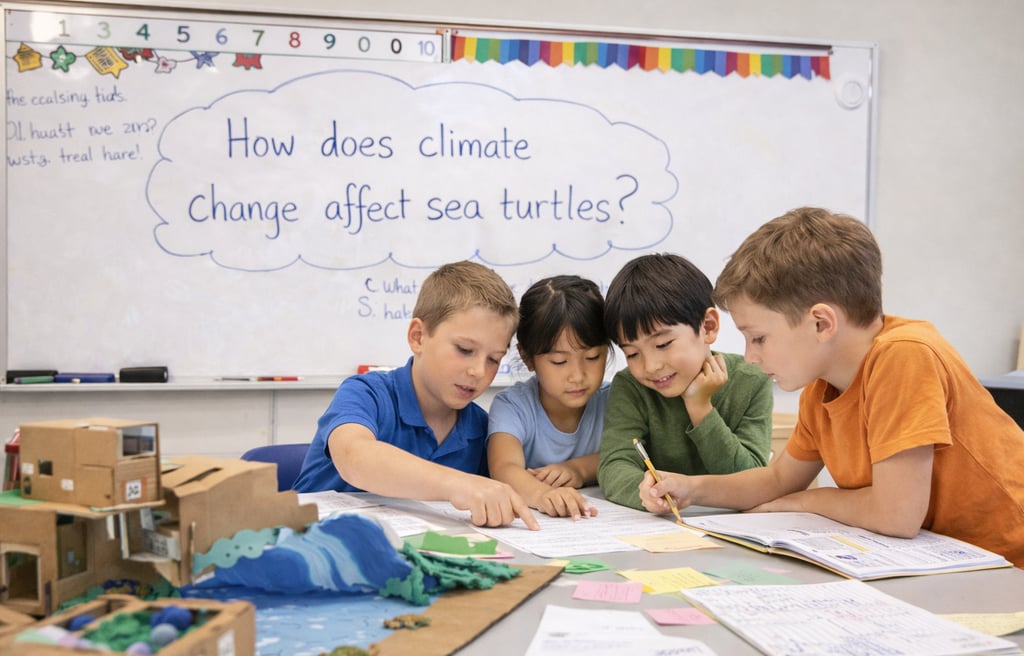
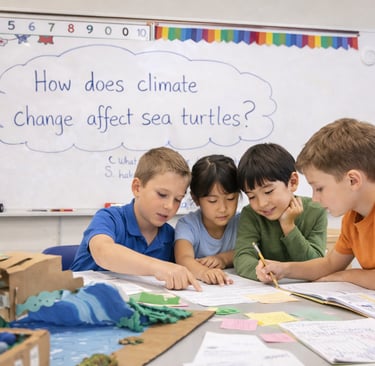
If you have ever opened your child’s notebook and wondered why they are researching how climate change affects sea turtles instead of memorizing a neat list of ocean facts, welcome to the world of the IB Primary Years Programme. This is usually the moment parents look at me during conferences, tilt their heads slightly, and ask a question that sounds polite but carries real confusion underneath it: Why is my child learning like this?
The short answer is that the PYP is built on curiosity, connection, and real-world thinking. The longer answer is that it quietly reshapes how children learn, not just what they learn. And once you understand the difference, it becomes surprisingly difficult to imagine going back to anything else. Here is what sets the PYP apart and why children tend to thrive inside it.
Learning Begins With Questions, Not Answers
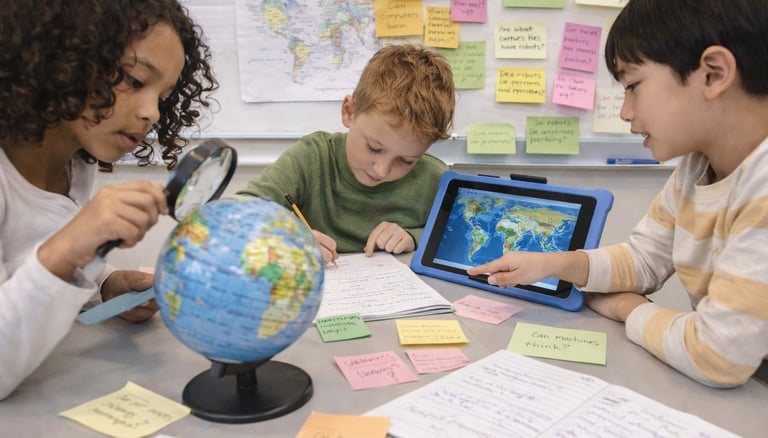
In a PYP classroom, learning does not start with the teacher opening a textbook and announcing today’s objective in bold letters. It starts with questions. Big ones. Messy ones. The kind that make adults pause mid-sentence. Why do people move to different countries? Can machines think? Why are some countries richer than others? Who decides what is fair? These are not warm-up questions. They are the engine of the lesson.
When learning begins with curiosity, children remember it. They remember what they question. They remember what they investigate. They remember what they argue about on the carpet and continue debating at lunch. Instead of sitting in the passenger seat waiting for directions, they are steering the learning themselves. Sometimes confidently. Sometimes wildly. Occasionally into a metaphorical ditch. But always engaged. And honestly, there is something deeply powerful about watching a child realize their questions matter enough to shape the direction of learning.
Kids Learn How to Think, Not What to Memorize
Here is a quiet truth most educators know: Traditional education is very good at training children to store information. Like tiny, polite hard drives. The PYP is far more interested in teaching them how to think. That is why a PYP classroom can look like organized chaos to the untrained eye. One group is researching migration patterns. Another is sketching maps with arrows pointing everywhere. Someone is building a model city out of cardboard and tape that absolutely should not be holding together but somehow is.
It all connects back to the same central idea, even if it does not look that way at first glance. The goal is not to fill the mind. The goal is to shape it. This means children spend time analyzing, questioning, comparing, reflecting, and revising ideas instead of racing through disconnected facts. And yes, it can feel uncomfortable at first.
Many adults were educated in systems where success meant finding the correct answer quickly. The PYP asks children to stay with uncertainty longer. To think more deeply. To explain their reasoning instead of memorizing someone else’s. Growth usually feels slower when it is real. But deeper thinking lasts longer than short-term memorization ever will.
Real World Connections Matter as Much as Content
In the PYP, children are not asked to memorize facts about the weather simply because weather appears on the syllabus. They track storms. They observe changes. They compare climates. They discuss how communities adapt and what happens when they cannot. A child studying water shortages may suddenly start noticing how long the tap runs while brushing their teeth. Another may begin asking why certain neighborhoods flood more than others. This is where learning becomes meaningful.
Children stop seeing knowledge as something trapped inside school walls and begin recognizing it in the world around them. They are not just learning science. They are learning responsibility. Awareness. Decision-making. Connection. This is often the moment parents notice a shift at home. Suddenly the dinner conversation changes from: “What grade did you get?” to: “Can I tell you something interesting I learned today?” That shift matters more than most people realize. Because when children can see themselves inside the learning, ownership grows naturally.
Reflection Is Treated as Real Work
Adults often move through life on autopilot and only stop to reflect when something goes wrong. The PYP tries to interrupt that habit early. Children reflect constantly. What was difficult today? What confused me? What helped me succeed? What would I change next time? I have watched eight-year-olds pause mid-sentence and say: “I think I rushed that part.” That kind of awareness does not happen accidentally. It is practiced. Slowly. Sometimes awkwardly. Often honestly.
Reflection teaches children that learning is not only about outcomes. It is also about understanding themselves inside the process. This habit builds metacognition, the quiet superpower behind confident learners. When children understand how they learn, they begin to take ownership of it, and that responsibility tends to stay with them long after individual units are forgotten.
Social and Emotional Growth Is the Foundation, Not an Extra
Every PYP teacher knows this truth, even if we do not always say it out loud: A child who feels safe, valued, and understood learns better. Social and emotional development is not treated as an occasional classroom activity squeezed in between “real learning.” It is woven into everything. Students collaborate. They negotiate. They disagree and still finish the project together. They learn how to listen without immediately planning their next sentence, and sometimes it is messy.
A group discussion may involve frustration, compromise, dramatic sighing, and at least one declaration that: “Nobody is listening to my idea.” That is learning too. In PYP classrooms, children gradually learn that disagreement is not failure. Mistakes are not humiliation. Different perspectives are not threats. Those lessons matter far beyond primary school.
Because eventually these children grow into adults who must work with others, solve problems, adapt, communicate clearly, and navigate uncomfortable conversations without emotionally collapsing over a group project about recycling. This is not a soft skill. It is a life skill. And it shows up long after the unit ends.
Students Become Researchers, Creators, and Communicators
If you walk into a PYP classroom expecting silent rows and perfectly synchronized note-taking, you will probably be disappointed. Children present findings. Conduct interviews. Build models. Debate ideas. Create projects. Explain their thinking in ways that feel meaningful to them. The goal is communication, not compliance. Sometimes the presenting voice is quiet. Sometimes it trembles. Sometimes a child forgets their words halfway through and starts again.
I once watched a student rehearse a presentation to a classroom plant because presenting to people felt too intimidating at first. Two days later, that same child stood in front of the class and shared their ideas anyway. Not perfectly. Not confidently. But courageously. That growth is difficult to measure neatly on a spreadsheet. But it is real, and it is happening in plain sight. The PYP values the understanding behind the learning, not just the performance of it.
Why Kids Who Learn This Way Thrive
This is why children tend to thrive in PYP classrooms. They are not trained simply to perform. They are trusted to think. They are encouraged to question, explore, reflect, create, collaborate, and connect learning to the real world around them. They do not just sit through lessons. They help shape them.
So if you ever open your child’s notebook and find mind maps, sketches, questions, reflections, sticky notes, arrows pointing in confusing directions, and half-finished ideas scattered across the page, pause before assuming the learning is incomplete. Very often, that messy thinking is the learning.
In a world increasingly obsessed with speed, scores, and immediate answers, the PYP teaches children something quieter and far more lasting: How to keep thinking when answers are not obvious. And long after children forget individual units, they remember what it felt like to be trusted with their own thinking.