From Confused to Confident: A Parent’s Crash Course in the IB PYP
Confused by IB PYP terminology and inquiry-based learning? This parent-friendly guide breaks down what the IB Primary Years Programme actually looks like in real classrooms, why children thrive in it, and how parents can confidently support learning at home without feeling overwhelmed.
IB PYP
5/17/20265 min read


You’ve heard the acronym. You’ve nodded politely during school meetings. You’ve smiled while another parent casually mentioned “inquiry” and “transdisciplinary learning” as though everyone naturally knows what those words mean. Meanwhile, you are quietly wondering if you accidentally joined an educational secret society.
If you are new to international schooling, the first encounter with the IB PYP usually goes something like this: You smile confidently. You nod thoughtfully. Then you Google “What is PYP?” in the parking lot before pickup. Don’t worry. You are absolutely not alone.
Let’s Decode the Letters First
PYP stands for the Primary Years Programme, part of the International Baccalaureate (IB) continuum of education. But that still does not answer the real question most parents are asking: What makes it so different? And more importantly… does it actually work?
The short answer is yes. The slightly longer answer is that the PYP is less focused on cramming information into children’s heads and far more focused on helping them become curious, thoughtful, capable humans who know how to think for themselves. Which sounds lovely in theory. Until your seven-year-old starts asking philosophical questions at bedtime while you are emotionally hanging on by a thread and just wanted everyone to brush their teeth peacefully.
Less “Fill-the-Bucket.” More “Light-the-Fire.”
Traditional education systems often focus heavily on delivering information and measuring how much a child can retain. The PYP flips that approach. Instead of simply memorizing facts, children are encouraged to investigate ideas, ask questions, make connections, and think critically about the world around them.
Questions like:
Why does the moon change shape?
How do communities solve problems?
Why do people migrate?
What responsibilities do we have toward the environment?
These are not bonus questions after “real learning.” They are the learning. And something important happens when children are trusted with meaningful questions. They become more engaged. Children stop asking: “Will this be on the test?” and start asking: “Can I tell you something interesting I discovered?” That shift changes everything.
You are not simply raising a child who knows the capital city of Madagascar.
(For the record, it is Antananarivo.) You are raising a child who wants to understand:
why geography matters
how environments shape people’s lives
and why some places have more access to resources than others
The PYP values curiosity because curiosity is what keeps learning alive long after facts are forgotten.
So… What Does It Actually Look Like?
This is usually where new parents become slightly alarmed. Because PYP classrooms rarely look like the classrooms many adults remember. You probably will not see silent rows of children filling out identical worksheets for six hours straight.
Instead, you may walk into:
group discussions
hands-on experiments
collaborative projects
role play activities
art integrated into science
children interviewing one another
giant inquiry walls covered in sticky notes
and at least one heated disagreement about cardboard engineering
There is often movement. Noise. Energy. And occasionally one child confidently announcing they plan to become an astronaut-politician-chef who also rescues sea turtles. Honestly, the ambition alone is impressive. To an outside observer, it can look chaotic. But underneath that energy is a carefully structured system designed around inquiry and connection.
The curriculum revolves around six transdisciplinary themes, such as:
Who We Are
How the World Works
Sharing the Planet
How We Organize Ourselves
These themes allow children to connect learning across subjects instead of experiencing math, science, literacy, and social studies as completely separate worlds. In other words:
children learn that knowledge works together, because real life does too.
The Secret Sauce: The Learner Profile
Here is where the PYP becomes something deeper than academics alone. The programme is not only interested in what children know. It also cares about who they are becoming. The IB Learner Profile includes traits like:
caring
reflective
principled
open-minded
balanced
knowledgeable
communicative
and willing to take risks in learning
And no, “risk-taking” does not mean your child suddenly skateboard-jumps off furniture while calling it inquiry-based learning. It means developing the courage to:
try
speak up
ask questions
make mistakes
and recover from them
These traits are woven into daily classroom life. A math lesson may include conversations about fairness. A science unit might explore ethical questions about sustainability. A class discussion could involve reflecting on how to disagree respectfully.
I once watched an eight-year-old stop halfway through an assignment and quietly say: “I think I rushed this part.” That level of self-awareness does not appear magically. It is practiced intentionally. And honestly, some adults are still developing reflective thinking during stressful email exchanges at work. The Learner Profile helps children see learning as something connected to character, not just performance. And that changes how children see themselves.
And Parents? You’re Part of This Too
One of the most surprising parts of the PYP for many families is how much parents are invited into the learning process. Not as homework police. Not as unpaid teaching assistants. But as partners. You will likely be encouraged to:
ask open-ended questions at home
talk about learning beyond grades
support curiosity and independence
reflect with your child
and engage with real-world conversations together
At first, this can feel unfamiliar. Many parents were raised in systems where learning looked very different: Memorize. Repeat. Test. Move on. Inquiry-based learning can initially feel less predictable. Sometimes children come home with more questions than answers. Sometimes their notebooks look like detective boards full of arrows, sketches, sticky notes, and unfinished thinking.
That can feel uncomfortable at first. Especially if you are used to learning looking neat and measurable. But messy thinking is often real thinking. And no, you will not be expected to memorize inquiry cycles or casually use phrases like “transdisciplinary conceptual understanding” over dinner. Although at some point your child may start answering your questions with another question. Congratulations. The inquiry cycle has officially entered your household.
So… Is It All Just Philosophy?
This is the question many parents quietly carry underneath everything else. 'It sounds wonderful, but are children still learning academics properly?" Yes. Absolutely. PYP students still learn literacy, math, science, research skills, writing, problem-solving, and academic content aligned with rigorous standards The difference is not the absence of academics. It is the approach.
Children are taught to:
apply knowledge
analyze ideas
ask questions
make connections
reflect on their thinking
and communicate understanding meaningfully
Research consistently shows that IB students often develop:
stronger critical thinking skills
higher engagement
greater confidence as learners
stronger social-emotional awareness
and deeper global understanding
And perhaps most importantly: many children genuinely enjoy learning more. Which feels like a detail education systems should probably value a little more often.
Still Feeling Lost?
That feeling is incredibly normal. The PYP has its own language, systems, and philosophy, and many parents initially feel like everyone else received instructions they somehow missed.
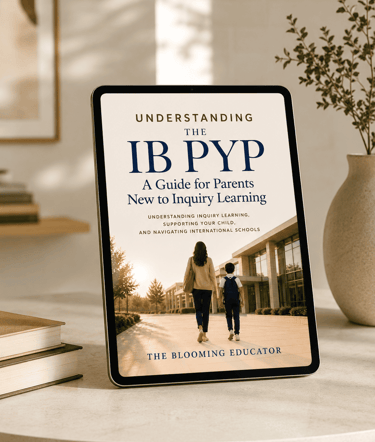
That is exactly why I created Understanding the IB PYP: A Guide for Parents New to Inquiry Learning, because parents should not need a translator just to understand their child’s education. The guide breaks things down in clear, practical language and helps you:
understand the framework without jargon
know what to expect in the classroom
support learning naturally at home
ask more meaningful questions after school
and feel more confident navigating the PYP experience
You do not need to become an expert overnight. You just need enough clarity to stop nodding nervously during parent meetings while secretly opening seventeen browser tabs afterward. And honestly, that is a very reasonable place to begin.
What Inquiry-Based Learning Looks Like at Home