How to Help Kids Calm Down after Screen Time
Struggling with screen-time meltdowns? Learn a gentle C.A.L.M. reset method to help children transition from screens to calm, connection, and offline play without daily battles or parent guilt.
SCREEN TIME & DIGITAL WELLBEINGCHILD BEHAVIOUR & EMOTIONAL DEVELOPMENT
5/31/20268 min read

I have seen this from both sides. As a parent, I have watched a child sit peacefully with a screen, calm as a tiny monk in pajamas, only to transform the moment the screen goes off. As a teacher, I have seen children arrive at school tired, wired, emotionally fragile, or strangely unable to settle into slower tasks. Not because they are “bad kids.” Not because their parents have failed. Not because childhood is officially doomed and we should all move to the mountains and raise goats.
Although, on certain afternoons, the goats do make a strong case. The truth is simpler and kinder than the usual online panic about screen time. For many children, the hardest part of screen time is not always the screen itself. It is what happens after. The bright colors stop. The fast movement stops. The music, game, cartoon, reward, or instant entertainment disappears. Then real life returns, carrying a pair of shoes, a dinner plate, a homework folder, or the deeply offensive suggestion that the child should now “go play.” And suddenly, your child is devastated.
“Just one more.”
“I wasn’t finished.”
“That’s not fair.”
“You always say no.”
“This is the worst day ever.”
It can feel dramatic. It can feel personal. It can feel like you are negotiating with a tiny lawyer who has never paid rent but somehow knows how to appeal every decision. But often, what we are seeing is not manipulation. It is transition difficulty. Children’s brains and bodies need help moving from screen stimulation back into ordinary life. And ordinary life, bless it, does not always come with animation, sound effects, or a reward button.
What I noticed as a teacher
In the classroom, I have learned that transitions matter. Moving from playtime to writing matters. Moving from lunch to learning matters. Moving from group work to independent work matters. Moving from excitement to stillness matters. Some children can shift quickly. Others need time, warning, repetition, and support. A child who struggles to stop an activity is not always being defiant. Sometimes they are overwhelmed by the change. Sometimes their body is still moving at one speed while the environment has suddenly demanded another.
That same thing happens at home with screens. A screen gives children instant stimulation. It is fast, bright, responsive, and often designed to hold their attention. Then, when it ends, real life asks them to regulate themselves. That is a big ask for a developing brain. As a parent, I understand the other side too. Sometimes screens happen because dinner needs to be cooked. Sometimes screens happen because adults need to answer messages.
Sometimes screens happen because everyone is tired and the house has reached that dangerous hour when one more loud noise might send someone spiritually into the wallpaper. So this is not a shame-filled post about how good parents never use screens. Good parents use screens. Tired parents use screens. Thoughtful parents use screens. Teachers who know all the research still sometimes use screens because real life is not a parenting brochure with soft lighting and a child gently stacking wooden blocks beside a vase of eucalyptus. The goal is not perfection. The goal is rhythm.
Why children melt down after screens
When screen time ends, some children experience a sudden drop. They have gone from something highly stimulating to something slower. Their brain may still want more. Their body may feel restless. Their emotions may rise quickly because the thing they were enjoying has been removed. Then we often say: “Go play.” But to a child who has just been deeply absorbed in a fast digital world, “go play” can feel too vague.
Play requires imagination. Play requires choice. Play requires patience. Play requires starting from nothing. And starting from nothing is hard when your brain has just been fed a full buffet of instant entertainment. This is why many children say, “I’m bored,” within seconds of the screen turning off. They may not need more entertainment. They may need a bridge back into real life.
What does not always work
I have tried the usual things. Many parents have. Repeating “screen time is over” in a louder voice, because apparently volume is our first draft of strategy. Giving long explanations while the child is already upset. Threatening consequences. Arguing with “just one more.” Taking the device away suddenly and hoping everyone will accept this decision with grace, maturity, and deep respect for household boundaries.
They usually do not. And honestly, I do not blame children entirely. If someone removed my coffee mid-sip and said, “Go fold laundry,” I might also need a moment. The problem is that many of our responses begin after the meltdown has already started. By then, the child is dysregulated. The parent is frustrated. The room is tense. Everyone is reacting. A calmer approach begins before the screen turns off. It gives the child a landing place. That is where the C.A.L.M. Reset Method can help.
The C.A.L.M. Reset Method
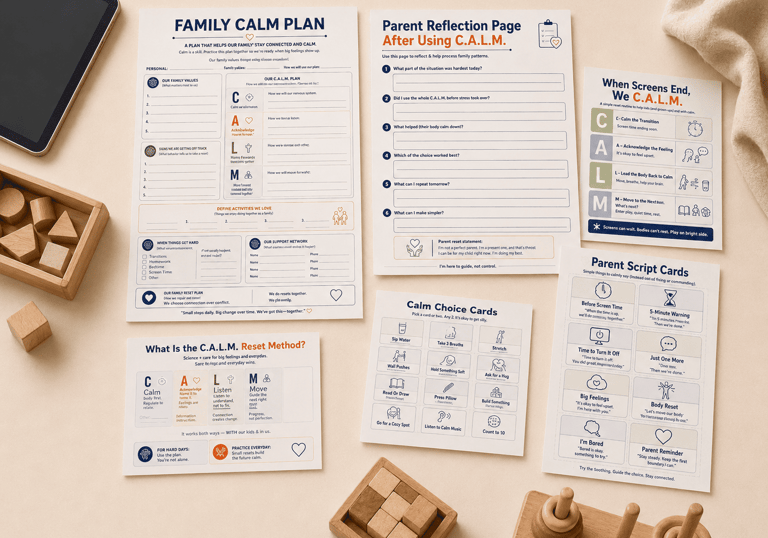
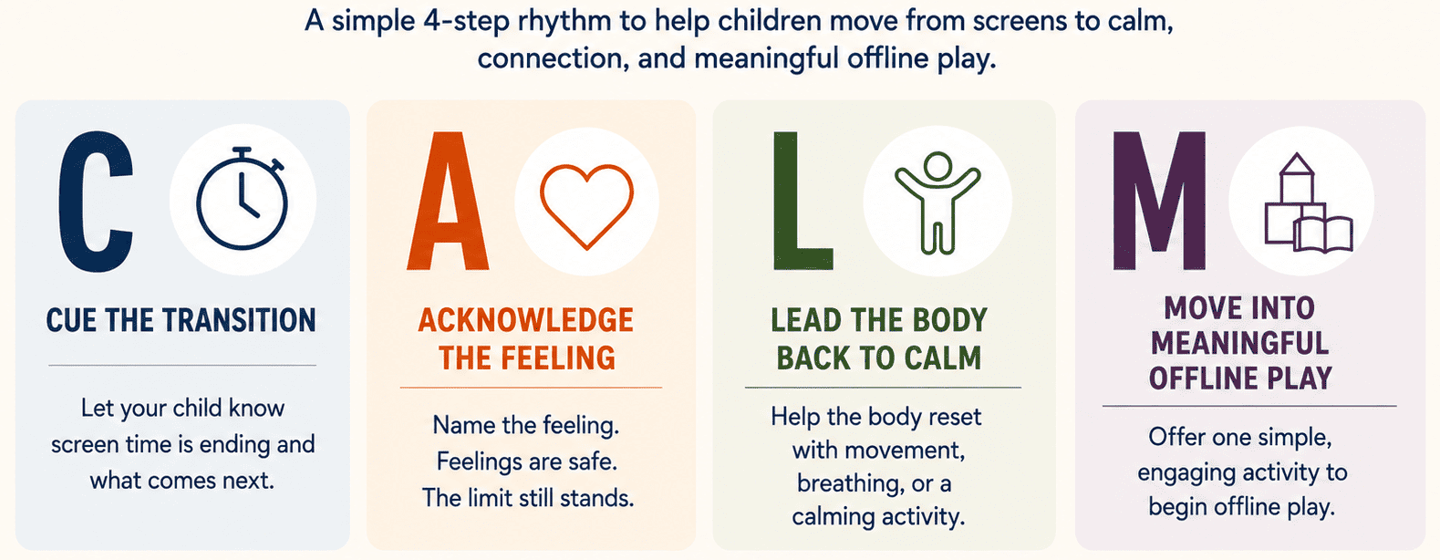
I created the C.A.L.M. Reset Method as a simple way to help children move from screens to calm, connection, and offline play. It stands for:
C: Cue the transition
A: Acknowledge the feeling
L: Lead the body back to calm
M: Move into meaningful offline play
It is simple enough to remember when your child is upset and you are mentally calculating how long until bedtime.
C: Cue the transition
Children handle endings better when they know they are coming. Instead of waiting until screen time is over and then announcing it like breaking news, prepare them. Try: “Five more minutes, then screens rest.” “After this show, we will drink water and choose one offline activity.” “When the timer rings, screen time is finished. I will help you choose what comes next.”
Even better, decide what comes after before the screen begins. “Before you watch, choose your after-screen activity. Drawing, blocks, or helping with snack?” This gives the child a landing place. A transition without a next step can feel like falling. A transition with a clear next step feels safer.
A: Acknowledge the feeling
This is the part many adults misunderstand. Acknowledging a feeling does not mean giving in. You can say: “You really wanted more screen time. I understand.” And still keep the screen off. You can say: “It is hard to stop something fun.” And still hold the boundary. You can say: “You are allowed to feel upset. The answer is still no.”
That sentence may not win a popularity contest in the moment, but parenting is not a popularity contest. If it were, bedtime would be at midnight and dinner would be biscuits with ketchup. Children need to know two things at once: Their feelings are safe. The limit still stands. That combination builds trust.
L: Lead the body back to calm
This is the step parents often skip, not because they do not care, but because most of us were never taught to do it. After screens, many children do not need a lecture. They need a body reset. Try one simple thing:
sip water
stretch
do wall pushes
take five slow breaths
jump and freeze
hold something soft
ask for a hug
listen for three sounds
sit in a cozy spot
read one page together
The body often calms before the mind does. When a child is upset, saying “calm down” rarely works. If it did, every parent would be relaxing in a spotless living room while children peacefully processed disappointment like tiny philosophers. Instead of saying “calm down,” help the body do something calming. “Let’s help your body reset.” “Choose water or stretching.” “First we move, then we choose.” Small. Simple. Repeatable. That is the secret. Not magical. Not glamorous. Definitely not viral. Just useful.
M: Move into meaningful offline play
After the body reset, children need a next step that feels possible. Not twenty choices. Not an elaborate craft that requires glitter, courage, and a parent with no meetings. Just one or two simple options. “Would you like drawing or blocks?” “Do you want to make a treasure map or build a tiny fort?” “Would you like to read one page or help set the table?”
The goal is not to fill every moment. The goal is to help the child begin. Some children need an adult nearby for the first few minutes. That does not mean the plan failed. It means they are practicing independent play with support. Over time, these small beginnings build confidence.
What to say when your child says “I’m bored”
This one deserves its own moment. Boredom is not an emergency. It can feel uncomfortable, especially for children used to quick entertainment. But boredom is often where imagination begins. When your child says, “I’m bored,” try: “Boredom feels uncomfortable at first. Let’s choose one small thing.” “You do not need a big plan. Just pick a tiny start.” “Would you like to create, move, imagine, explore, or help?” Some easy boredom rescue ideas:
draw a monster
build a tiny fort
make a treasure map
fold a paper airplane
create a pretend shop
sort toys by color
read one short page
help set the table
go on a nature hunt
make a sticker story
These are not magic tricks. Your child may not gasp with gratitude and say, “Thank you, wise parent, for restoring my imagination.” They may sigh first. That is okay. A sigh is not failure. Sometimes a sigh is just imagination turning back on, slowly and with mild complaints.
What progress actually looks like
When families start changing screen routines, the first goal is not zero meltdowns. The first goal is noticing patterns. Maybe the meltdown is shorter. Maybe your child accepts the warning more easily. Maybe they choose one offline activity with less resistance. Maybe you stay calmer. Maybe bedtime feels slightly less like a hostage negotiation with toothpaste involved. That counts.
One hard transition does not mean you failed. It means your child is practicing a difficult skill. Children do not learn emotional regulation in one perfect moment. They learn through repetition, connection, repair, and steady boundaries. So do adults, honestly.
There have been days when I have handled a screen transition beautifully. Calm voice. Clear boundary. Loving support. A true parenting brochure moment. There have also been days when I have said, “That is enough screen time,” in the tone of someone who has already mentally resigned from the day. That is real life. The point is not to get it perfect every time. The point is to have a way back.
When extra support may be needed
Most screen-time struggles are normal family challenges, but sometimes they are part of something bigger. If your child’s screen transitions regularly involve extreme distress, aggression, major sleep disruption, intense anxiety, or daily functioning problems, it may help to speak with a pediatrician, counselor, teacher, or child development professional. Asking for help is not overreacting. It is paying attention.
A gentle next step
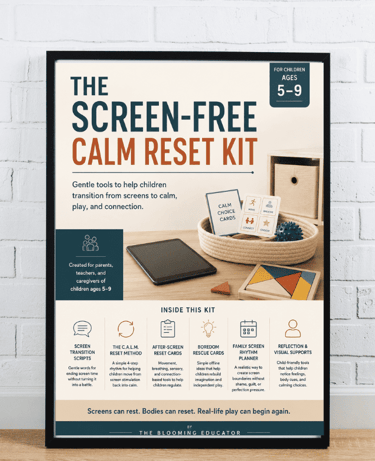
If screen-time endings are one of the hardest parts of your day, I created The Screen-Free Calm Reset Kit to give you something practical to reach for in the moment. Not another lecture. Not another perfect-parent checklist. Not another resource pretending real families calmly discuss boundaries while the soup simmers and everyone wears linen.
Just clear words, visual tools, calm choices, boredom rescue cards, parent scripts, posters, and a weekly tracker that help your child move from screen stimulation back into real-life calm. It is designed for children ages 5–9 and made for real homes, real classrooms, and real adults who are trying their best.
The goal is simple: Screens can rest. Bodies can reset. Real-life play can begin again.
Because your child does not need you to win the screen battle. They need you to guide the landing. And you deserve tools that help you do that without guilt sitting on your shoulder like an unpaid supervisor with a clipboard. You are not trying to raise a screen-free statue. You are helping a real child learn how to return to real life, one calmer transition at a time.